How Do Leaders Get Their Organizations From Vision to Action?

Model the Way, Inspire a Shared Vision, Challenge the Process, Enable Others to Act, Encourage the Heart”  Kouzes and Posner


I attended the annual CII conference in July this year and was really impressed with the quality of the presentations and tools that were offered. Construction Industry Institute, CII, was initiated by the University of Texas and is a collaboration between academia and industry to research some of the tough issues that industry faces and to come up with practical approaches and tools to deal with these problems.

Every year, CII selects a number of these tough problems and creates research teams comprised of academia (professors and grad students), representatives from owners, construction companies, engineering firms and suppliers to research these problems and come up with potential solutions. Each team has 2 years to do its research and to compile the results along with tools or guidelines to help address the problem identified.

Every year, CII holds its annual conference and the research teams report out their findings to the conference attendees. I would highly recommend membership in CII to anyone that is involved in engineering or construction.

Why Are You So Focused On Your Competition?

The competitor to be feared is the one who never bothers about you at all, but goes on making his own business better all the time.” Henry Ford

I find it very interesting that about 100 years ago Henry Ford, the inventor of the mass production factory, understood that focusing on your competition added no value to your business. In fact, he knew that focusing on your competition takes your focus off your own business. Focusing on the competition causes you to chase others rather than leading your organization towards achieving your goals, mission and vision.

So if Mr. Ford identified the secret about what to focus on as a business leader 100 years ago, why are so many business leaders today so concerned about what their competition is doing?

The Secret of Organizational Change Management

In the 2014 summer version of Strategy + Business magazine, there was an article entitled “10 Principles of Leading Change Management.”  This article ties nicely into one of my previous blog posts “The Protean Corporation” that was focused on what corporations need to do to deal with the continuous and explosive change that they are faced with everyday. That blog post was focused on the organizational structure and culture required for our changing environment while this post is focused on rolling out change within the organization itself.

The 10 guiding principles for change as described in the article are summarized below (with some of my commentary added);

1) Lead with the culture – when building your strategy for rolling out the change, take into account your organizations vision, mission, values and overall culture. Does the change align with the vision, mission, values and culture? How can you structure or position the change to leverage these things and make it easier for the organization to accept and embrace the change?

Who Wants Clarity Around Organizational Leadership Behaviors?

I have written about the Business Compass tool in a number of blog posts recently. The Business Compass is a tool that can be a very powerful way of communicating your organization’s;

1)  Vision

2) Mission

3) Values

4) Strategic and Operational Priorities

5) Brand Promise

6) Leadership behaviors

I have defined all the components of the Business Compass except for Leadership Behaviors in past blog posts. So, what are Leadership Behaviors?

What Everybody Can Learn About Business From Mountain Biking

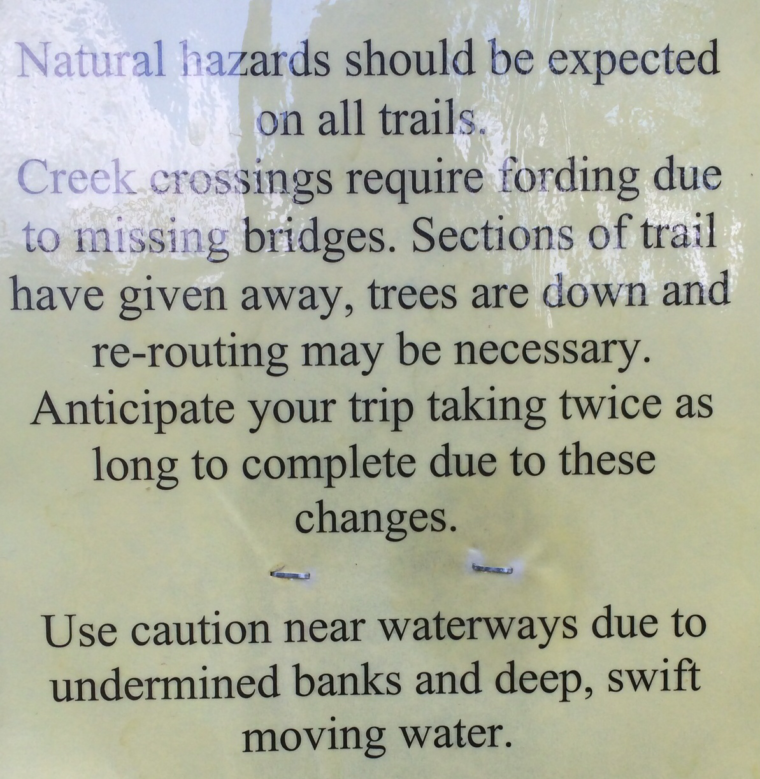
I am an avid mountain biker and recently went on a ride that I have done many times in the past. It is a 28 mile single track ride in the Canadian Rockies that climbs and then descends over 4300 feet. In good weather I typically complete this trip in 3.5 hours. This time, however, it took me 5.5 hrs as I did not see the warning sign at the train head (picture above) until after I was finished! Due to significant flooding the previous year, the trail was literally destroyed in many places and required a lot of detours and carrying my bike while dealing with washouts, rock avalanches, mountains of debris and missing bridges.

Mountain biking 2


I could not help thinking about the parallels between mountain biking and business as I was fighting my way through these obstacles. I have listed some of them below;