What Are SMART Goals and Why Should You Care?

Business goals that are well worded, feel-good platitudes are useless. Properly defined SMART goals that your staff understand and contribute to, will align your organization and drive it towards your mission and vision!

Everyone has been talking about setting SMART goals for years so I am amazed at times when I see corporate goals that are really just a high level objective statement. Business leaders must set SMART goals if they want their organizations to be aligned and motivated towards goal achievement.

I have seen many examples over the years of how powerful SMART goals can be. I have seen:

How To Set, Monitor and Reach Your Business Goals

Are you on track to meet your business’ financial targets this year? What are your current monthly run rates? Are your expenses too high for the revenue you are producing? How do you know? Did you set financial goals and targets for the year?

One of the most important aspects of a business leaders’ role is setting the overall direction for their organization. Part of the overall direction that an organization requires is to have clearly established financial targets. Once these targets are set, the leader’s job is to track the performance against the targets and to strategically lead the organization to meet or exceed the targets.

What Does Ray Dalio Have To Do With Your Business And Why Is It Important?

Ray Dalio is the founder of the investment firm Bridgewater Associates. He had an estimated net worth of $15.4 billion in 2014 according to Forbes! So, what does Ray Dalio have to do with your business?

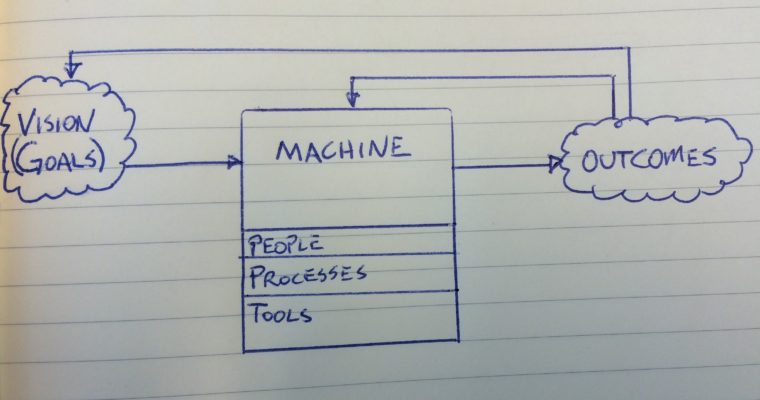
Probably nothing directly. But, based on his net worth, Dalio knows business so we should learn from him! He came up with a simple model that describes a business or an organization that has worked well for him over the years. I would suggest that understanding his simple model is critical to the success of your business. The model is shown in the picture for this blog post (note that I have exercised my artistic license and added a few items for clarity!)

As business leaders, each of us is responsible to produce results in our organizations. Results drive our businesses. Without achieving positive results, a business is really worthless. Dalio‘s model illustrates that a business starts with a Vision and then delivers business results or Outcomes through a Machine. The model stresses that the Outcomes are a direct result of the Vision and the Machine (both of which are defined below);

How to Get the Pulse of Your Organization – Part II

Back in May 2014, I wrote a blog post entitled How to Get the Pulse of Your Organization. In this post I described two techniques that can be used to effectively communicate and lead your organization; “Did You Know” emails and a web based employee feedback system. In this week’s article, I will introduce two other techniques that I used to communicate and keep my finger on the organization’s pulse.

  1. Monthly lunch with the leader – Pick a random set of employees each month to have lunch with you. Do not repeat employees until everyone in the organization gets a turn. A group size of 10 to 20 works best. Use these lunches as open mic sessions for employees to ask you whatever questions they may have. Be open and honest with your answers and wherever possible tie the answers back to the organization’s vision, mission, values and goals. Above all else, listen intently to the feedback, take notes and never get defensive. These sessions are your opportunity to hear what your organization is thinking and talking about. If the conversation starts out slowly, you can prompt discussion by asking questions like;

Are You Getting Beaten By the “Tyranny of Small Decisions”?

In 1966, Alfred E. Kahn wrote an essay entitled “The Tyranny of Small Decisions.” Khan was an economist and his essay was predominately focused on economics. However, the concept defined in the essay applies to each of us and can profoundly impact business and business leaders.

So what is the tyranny of small decisions? In a nutshell, it is what results when a person, group of people, business or organization make a number of small decisions over a period of time. These decisions are not bad decisions on their own but, taken together over a period of time, the result of the decisions are diametrically opposite from the outcome desired.

For instance, take the super busy executive running his business day to day without a clear set of values or a defined vision, mission and goals. This person is going to make decisions each day that seem correct and make sense at that moment but the sum of these decisions could add up to a disaster over the long term. Without the long term view of the business and a proper focus on what is to be achieved, the executive will make “firefighting” decisions that may take care of the issues at hand but destroy the business overall.